
Commercial Roofing Contractors Downtown Appleton, WI
Commercial Roofers in Downtown Appleton
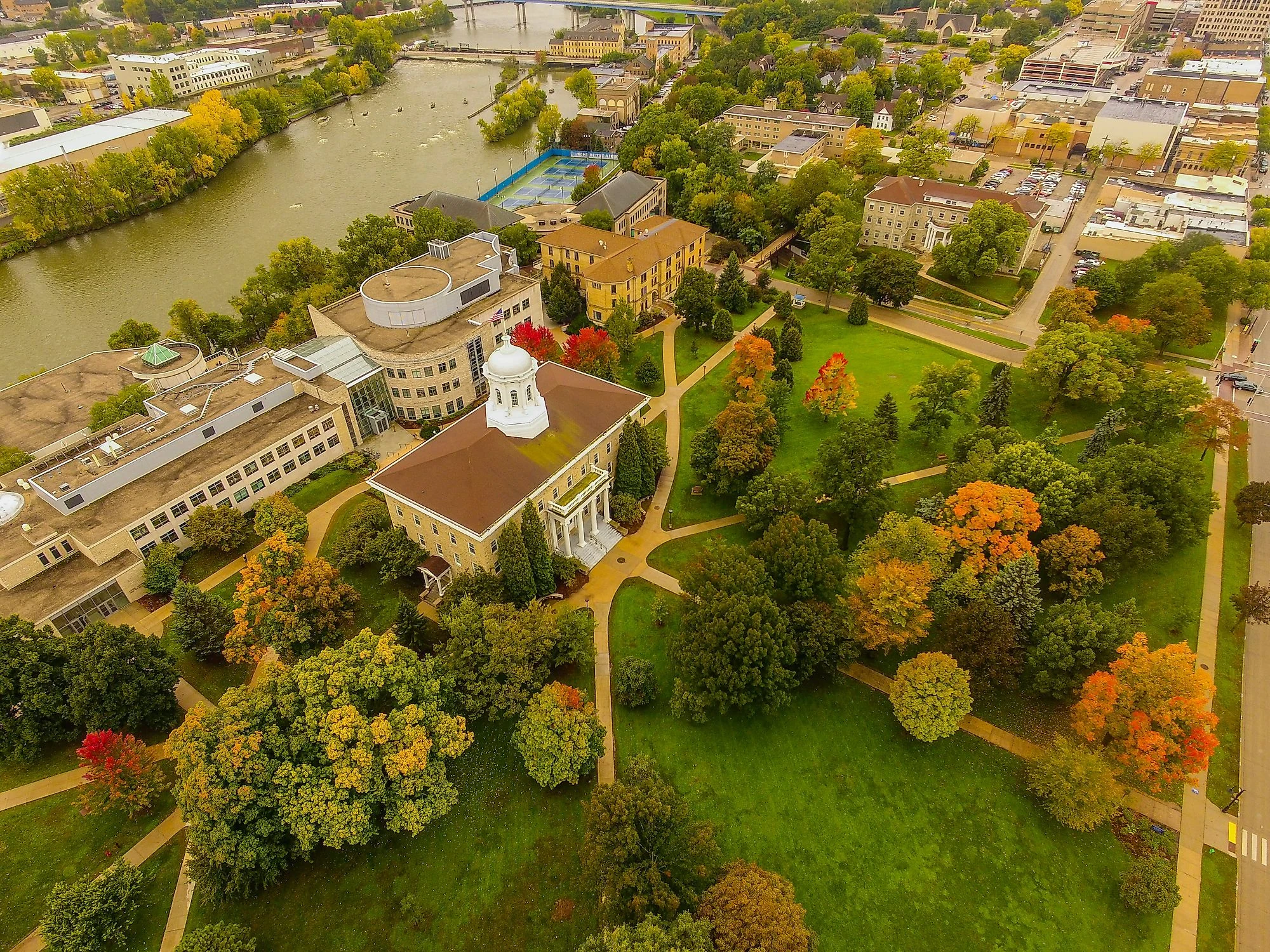
Commercial roofers serving Downtown Appleton should document leak sources, wet insulation, drainage, edge details, penetrations, and repair history before recommending a scope. Downtown Appleton runs along College Avenue between the Fox River and Lawrence University, a mix of century-old masonry storefronts, the Fox Cities Performing Arts Center, and university buildings packed close together. Most of the roofs up here are flat or low-slope, hidden behind parapet walls you can't see from the sidewalk, and a lot of them are older than the businesses currently operating underneath them. We work this stretch often enough to know which buildings still carry a built-up roof from decades back and which ones have already been recovered.
Old Masonry, Older Roofs
A large share of downtown Appleton's commercial buildings still have a built-up roof over a wood or gypsum deck, installed long before energy code required the insulation thickness we'd spec today. On a lot of these buildings the membrane has been patched repeatedly rather than replaced, and the roof underneath has more history than any single owner's records show. Before we quote a job downtown, we probe the deck and check moisture content in the existing insulation, because a recover over a wet substrate just traps the problem under a new layer.
When a recover makes sense, we usually add tapered insulation to correct decades of ponding and bring the assembly's R-value up to something closer to current code. That's often the single biggest improvement we make on an old downtown roof, more valuable long-term than the membrane brand on top of it.
Working Near Lawrence University and the Performing Arts Center
Buildings near Lawrence University's campus and the Fox Cities Performing Arts Center stay occupied on schedules that don't leave much room for a roofing crew to improvise. The PAC in particular has a large-span roof over a theater space with different moisture and acoustic-isolation requirements than a typical retail building, and a leak there affects finished interior spaces that are expensive to dry out. We plan those jobs around performance and class calendars, not the other way around.
Access downtown is its own constraint. There's rarely room for a crane on College Avenue, so material handling usually means a mini-crane staged in an alley, a hoist through a roof hatch, or hand-carrying bundles up a narrow interior stairwell. We plan the logistics before we plan the roofing sequence, because a delivery that can't get to the roof stalls the whole job.
Internal Drains and Box Gutters Behind the Parapets
A lot of downtown Appleton's flat roofs drain through internal roof drains or box gutters built into the parapet line rather than exterior scuppers, and those systems fail quietly. A clogged internal drain doesn't show up as an obvious leak until water backs up over the drain bowl and finds a seam somewhere else on the roof. We treat drain service as routine work here, not an afterthought.
- Internal roof drain clearing and camera inspection down the leader line
- Box gutter relining where the metal or membrane liner has thinned
- Parapet cap flashing resealing at coping joints
- Scupper and overflow drain testing before storm season
- Tapered insulation crickets built into drain sumps to eliminate standing water
- Pitch pocket resealing around older rooftop conduit penetrations
Ice damming is the downstream effect of a slow drain on a downtown roof. Meltwater backs up behind the parapet wall, refreezes overnight, and works its way under flashing that was fine in October. We recommend clearing internal drains before the first hard freeze specifically because of how these roofs are built.
Snow Load Behind Tall Parapet Walls
Parapet walls that run higher than the surrounding roofline trap drifting snow differently than an open commercial roof would. Wind pushes snow up against one side of a downtown parapet and drops it there instead of scouring it off the field, which means the load on that section can run well above what falls elsewhere on the same roof. We factor that into any recover or new membrane spec on a building with a tall parapet.
Before adding insulation or a second membrane layer to an old downtown roof, we also want to know what the structural deck can actually carry. A lot of these buildings were framed for a lighter original roof assembly, and stacking too much dead weight on an aging wood deck without checking it first is how a roofing job turns into a structural problem.
What Downtown Appleton Property Owners Ask Us
Is my building's roof still the original one?
Often, at least in part. Many downtown roofs have been patched and partially recovered over the years without a full tear-off, so we check exposed edges and probe the deck to piece together what's actually up there before quoting anything.
Can you schedule around events at the PAC or classes at Lawrence?
Yes. We build the work sequence around occupied-building schedules downtown as a matter of course, and we coordinate access and noisy work windows with building management ahead of time.
Why do downtown roofs get ice dams more than newer suburban buildings?
Tall parapets trap snow and hide internal drains from routine view, so a slow drain problem builds up unnoticed until meltwater backs up and refreezes at a flashing seam.
How do you get materials onto a roof with no room for a crane?
Alleys, roof hatches, and interior stairwells, depending on the building. We plan material handling before we plan the roofing sequence on any downtown job.
Should an old built-up roof downtown be recovered or torn off?
It depends on deck condition and how much moisture is already trapped in the existing insulation, which is why we probe the roof before recommending either path.