
PVC Roofing Systems in Appleton, WI
PVC Membrane for Chemical- and Grease-Exposed Fox Valley Roofs
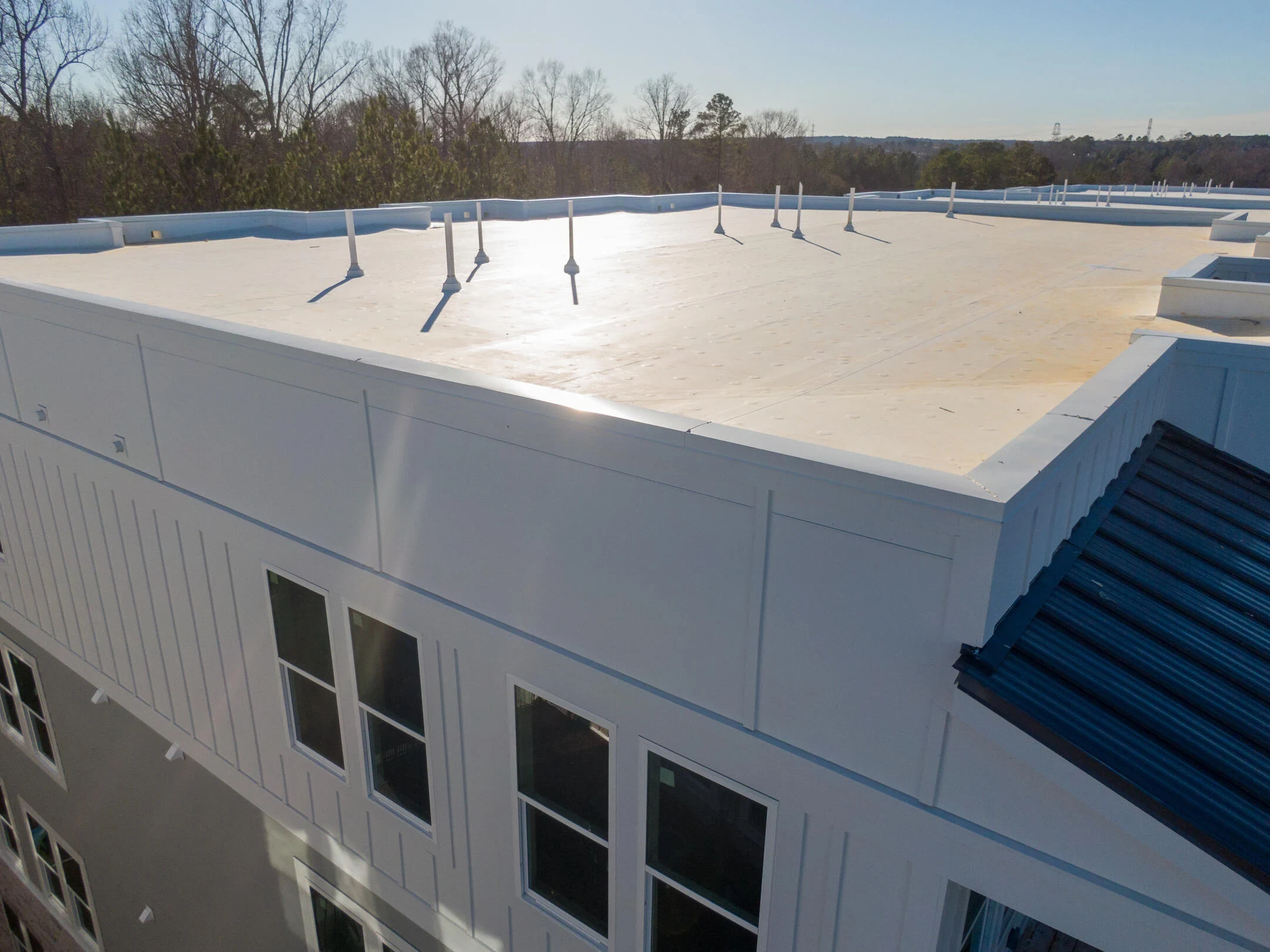
PVC is the membrane we reach for when a roof deck faces something other than plain weather. Grease exhaust from a food processing line, chemical vapor drifting off a nearby industrial process, or rooftop equipment handling anything other than clean air all point toward PVC over a standard TPO spec.
Where the Fox Valley Actually Needs Chemical Resistance
Food processing facilities in Little Chute's industrial park and the pet-food manufacturer's operation in Chilton both run kitchen and process exhaust across rooftop paths, and grease-laden air degrades most single-ply membranes over time if it is not accounted for in the material choice. TPO's polymer formulation is more vulnerable to plasticizer migration and grease attack than PVC's, which is compounded specifically to resist oils, fats, and many industrial chemicals.
Paper mill operations along the Fox River corridor, including the mill sites in Kaukauna and Combined Locks, generate process exhaust with sulfur-bearing compounds from pulping and bleaching operations. Roofs downwind of that exhaust, even on buildings not directly part of the mill operation, see more aggressive airborne chemical exposure than a typical office roof, and that changes the membrane conversation.
Welded Seam Chemistry Compared to TPO
PVC seams weld with hot air the same way TPO seams do, but the underlying polymer chemistry is different, and PVC's plasticized formulation generally produces a more chemically resistant weld zone against oils and solvents than TPO's unplasticized sheet. That difference is exactly why PVC shows up disproportionately on food service, restaurant exhaust, and grease-trap-adjacent roof areas across the industry, not simply in the Fox Valley.
The tradeoff is that PVC's plasticizers can migrate out of the membrane over very long service periods if the formulation or manufacturer quality is poor, which is why we specify PVC systems from manufacturers with a documented long-term plasticizer-retention track record rather than treating all PVC sheets as interchangeable.
Where PVC Outperforms TPO on Fox Valley Buildings
- Roofs downwind of kitchen, restaurant, or food-processing exhaust hoods
- Buildings near industrial chemical or solvent vapor exposure
- Roofs with rooftop grease-trap or exhaust fan equipment requiring a resistant membrane underlay
- Facilities where oil or hydrocarbon spill risk exists from rooftop mechanical equipment
- Reroofs replacing a membrane that failed early from chemical attack rather than age
Cold-Weather Handling and Sheet Flexibility
PVC stays workable at lower temperatures than some single-ply alternatives, which is a practical advantage during Fox Valley shoulder-season installs when we are racing daylight and temperature windows on a reroof schedule. The sheet does not stiffen as dramatically in cold ambient conditions, which keeps handling and detail work at curbs and penetrations more manageable through a late-fall install.
We still apply the same welding-temperature discipline as with TPO, probing every seam and adjusting welder settings as ambient conditions shift through the day, because cold air still slows the time it takes the weld zone to reach proper fusion temperature regardless of how the sheet handles by hand.
Cost Compared to TPO and When It Is Worth It
PVC generally prices above TPO on a material basis, and for a roof with no chemical or grease exposure, that premium buys little the building actually needs. We do not default to PVC across the board; we spec it when the exposure profile calls for it specifically.
On a roof with confirmed grease or chemical exposure, the math flips. A cheaper membrane that fails early from chemical attack costs more over the roof's service life than the PVC premium paid up front, and we walk owners through that comparison with the specific exposure source identified rather than a generic upsell pitch.
Detailing at Penetrations and Rooftop Equipment
Food processing and industrial buildings tend to carry more rooftop penetrations than a standard office roof: exhaust stacks, grease-duct curbs, process vents, and equipment platforms all puncture the membrane field. PVC's weldability extends to prefabricated flashing boots and corner pieces, which speeds detail work around these penetrations and reduces the number of field-fabricated seams that could become future leak points.
We inventory every penetration during the roof walk and match flashing details to the specific equipment on that roof rather than using a generic detail set, since a grease-exhaust curb and a standard HVAC curb need different flashing treatment.
Questions Fox Valley Owners Ask About PVC Roofing
Does my building actually need PVC instead of TPO?
Only if there is grease, oil, chemical, or solvent exposure on the roof. Without that exposure, TPO usually performs just as well for less cost.
How does PVC hold up near paper mill exhaust?
PVC's chemical resistance generally outperforms TPO against sulfur-bearing process exhaust, though the specific exposure level on a given roof should be assessed rather than assumed.
Is PVC more expensive to install than TPO?
Material cost typically runs higher. Whether that premium is worth paying depends on the roof's actual chemical or grease exposure.
Can PVC be welded in cold Wisconsin weather?
Yes, and the sheet handles somewhat better in cold ambient temperatures than some alternatives, though weld-zone temperature still needs to be managed carefully.
Will PVC plasticizers break down over time?
Formulation quality matters here. We specify systems from manufacturers with a documented plasticizer-retention record rather than treating every PVC sheet as equivalent.
Related
Ready to review the roof scope?
Request a Roof AssessmentPVC Details for Grease, Steam, and Process Roofs
PVC is often evaluated for food service, processing, and other roofs where grease, oils, or process discharge could reach the membrane. We map exhaust locations, prevailing drainage paths, cleaning practices, and rooftop traffic before deciding how much of the roof needs that resistance profile. A membrane choice cannot compensate for a leaking curb, open pitch pocket, damaged drain bowl, or unprotected service route, so those items stay visible in the same scope. For occupied Fox Valley facilities, we also coordinate work around production schedules, kitchen operations, and air intakes. The final assembly record identifies PVC membrane areas, welded transitions, equipment details, protection zones, and any adjacent roof system that remains, giving maintenance teams a clear basis for compatible future repairs.