
Black EPDM Roofing in Appleton, WI
Black EPDM on Appleton's Older Commercial Roof Stock
Black EPDM has been on Fox Valley roofs longer than any single-ply alternative, and a meaningful share of the older commercial buildings downtown and along the Fox River still carry it in some form. It is not the default spec on a new build anymore, but on the right re-cover it is still the right membrane.
Why It Is Still the Right Call on Certain Re-Covers
We reach for black EPDM most on buildings where the existing roof is already an EPDM assembly in reasonable condition and the owner wants a re-cover rather than a full tear-off. Matching membrane chemistry to what is already on the deck avoids compatibility questions between old ballast, adhesives, and a new welded thermoplastic sheet. Some of the smaller commercial buildings around Little Chute's industrial park and older strip retail near downtown Appleton fall into this category.
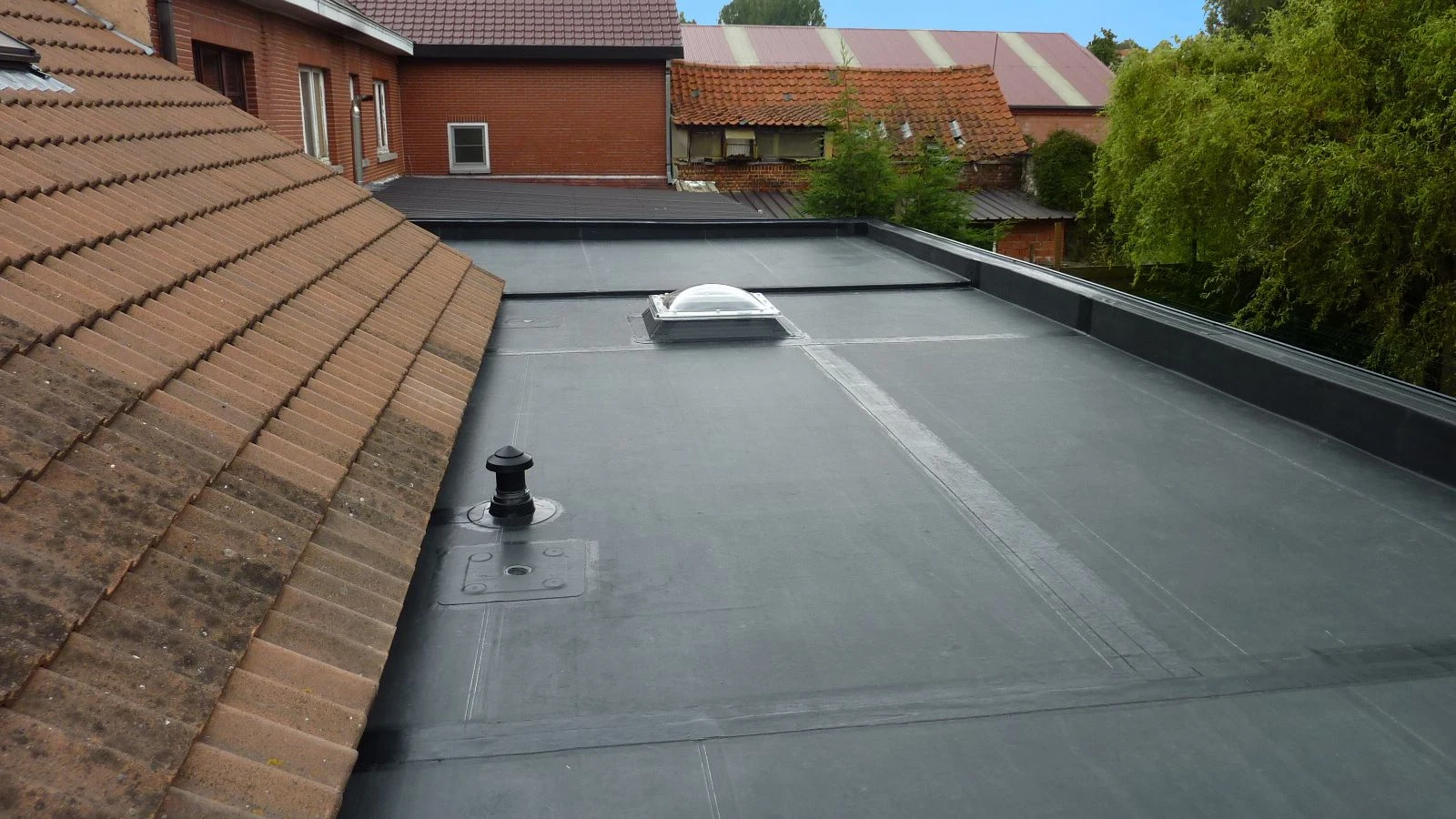
The membrane itself is a vulcanized rubber sheet, seamed with adhesive tape rather than hot-air welded, which changes the seam chemistry and the failure pattern compared to TPO or PVC. Seam failures on EPDM tend to show up at the tape edge as adhesive fatigue rather than a weld-line separation, and that changes how we inspect and maintain it.
Solar Gain and Ice-Dam Behavior in a Cold Climate
Black membrane absorbs more solar radiation than white or gray membrane, which sounds like a liability in a Wisconsin winter until you look at what it does at the roof edge. That extra heat gain can reduce the freeze-thaw cycling that drives ice dams at parapets and low-slope transitions on some roof geometries, since the membrane surface runs warmer during marginal winter days than a reflective membrane would.
The tradeoff shows up in summer, when the same black surface runs hotter under direct sun, which accelerates long-term UV degradation of the membrane's carbon-black-stabilized top surface faster than a white membrane would weather. Neither effect is dramatic on its own, but we factor both into the service-life conversation rather than treating color as a purely aesthetic choice.
Ballasted Versus Fully Adhered Assemblies
Ballasted EPDM, loose-laid membrane held down with river rock or paver ballast, is still common on older flat-roof buildings in the Fox Valley because it was the standard install method for decades. Ballast adds real dead load to the roof structure, which we confirm against the original design load before recommending a ballasted re-cover on any building where the framing has not been reviewed recently.
Fully adhered EPDM skips the ballast weight entirely, bonding the membrane directly to the insulation with adhesive, and is generally our preference on re-covers where structural load is a question or where wind uplift design pressure makes a ballasted system impractical for the building's height or exposure.
Where Black EPDM Still Makes Sense
- Re-covers matching an existing EPDM assembly still in serviceable condition
- Lower-visibility roofs where reflectivity and cool-roof credit are not project priorities
- Ballasted assemblies on structures with confirmed load capacity for the rock or paver system
- Buildings prioritizing lower material cost over the reflective-membrane premium
- Roofs with simple geometry and low penetration counts, where EPDM's sheet size is an installation advantage
Seam Maintenance and Long-Term Wear
Adhesive-taped seams need a different maintenance eye than welded thermoplastic seams. We check tape edges for lift, look for adhesive that has gone brittle or chalky, and probe questionable areas during routine inspections rather than waiting for a leak to show up on a tenant's ceiling. Freeze-thaw cycling through a Fox Valley winter puts real stress on any seam that has already started to lift, so catching tape fatigue early keeps a small repair from becoming a section re-seam.
Punctures and splits are the other common EPDM failure mode, usually from foot traffic, hail, or debris rather than membrane age alone. The material patches cleanly with EPDM-specific primer and cured or uncured flashing tape, which is one advantage it holds over some thermoplastic systems on older roofs with irregular damage.
Questions Fox Valley Owners Ask About Black EPDM
Is black EPDM still a good option for a Wisconsin roof?
On the right building, yes, particularly for re-covers matching existing EPDM or where reflectivity is not a priority. It is not our default new-install recommendation anymore, but it remains a sound choice in specific situations.
Does black EPDM cause ice dams?
Solar gain from the dark surface can actually reduce some freeze-thaw cycling at the roof edge during marginal winter days, though roof geometry and insulation levels matter more than membrane color alone.
How long does black EPDM typically last in this climate?
Service life depends heavily on seam maintenance, foot traffic, and installation quality more than on the climate alone. We do not quote a blanket number without walking the specific roof.
Can black EPDM be installed over an existing ballasted roof?
Sometimes, if the existing ballast and insulation are dry and sound, but we confirm structural load capacity before recommending it rather than assuming the original design accounted for a second layer.
Why would someone choose black EPDM over white EPDM?
Lower material cost, matching an existing assembly, and reduced concern about cool-roof reflectivity requirements are the usual reasons. Building use and energy goals drive the final call.