
Commercial Roofing Contractors Menasha, WI
Commercial Roofers in Menasha
For commercial properties in Menasha, the defensible choice between repair, restoration, and replacement starts with roof-system condition, moisture findings, drainage performance, and remaining service life. Menasha sits where the Fox River leaves Lake Winnebago, split by Doty Island from Neenah and connected to Appleton by Highway 41 and Highway 10. Roof work here splits between legacy paper-converting plants along the river and a smaller but growing retail base near the marina district downtown.
Paper Converting Plants Along the Fox River
Menasha's converting plants sit close to the water, and buildings this old typically carry roof systems that have been patched, coated, or partially recovered more than once. Before we quote a project on one of these plants we cut a test section to see what's actually stacked under the current membrane, since a partial recover can hide wet insulation or an outdated fastening pattern that changes the whole scope.
Production floors that run continuous or near-continuous shifts mean we section the roof and sequence work to keep containment tight over whatever is running below, and we coordinate crane and lift access around loading docks and rail spurs that some of these older plants still use.
Interior process heat and humidity from converting operations pushes moisture up through the roof assembly over time, and we check vapor retarder condition and venting on these buildings rather than assuming a standard commercial vent detail is doing the job.
Rail spur access at some of the older plants means loading and unloading traffic can run directly adjacent to a building's roof edge, and we account for that when planning material staging, keeping crane and lift positioning clear of active rail movement rather than assuming the yard is available whenever we need it.
The Marina District and Downtown Retail
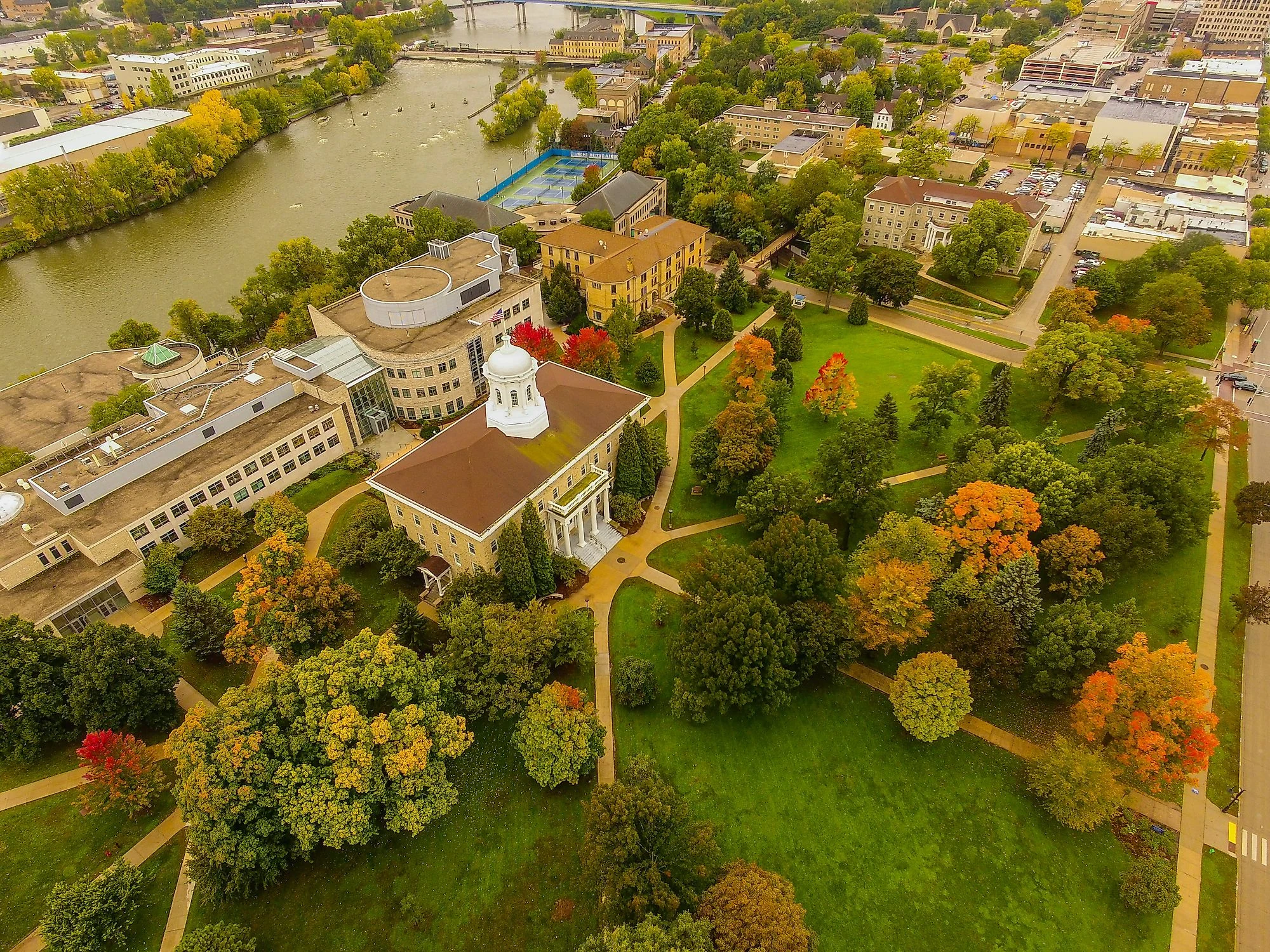
Menasha's downtown and marina district near the Trestle Trail and the river locks carry a mix of smaller retail and office buildings, many of them older masonry structures with flat roof additions built on over the decades. Visibility matters more here than at an industrial site, since rooftop equipment and roof edges are seen from the marina, the trail, and neighboring storefronts.
We plan edge metal and mechanical screening with that visibility in mind on downtown buildings, and we coordinate staging around foot traffic and boat trailer parking near the marina during warmer months when the area is busiest.
A fair number of these buildings run smaller HVAC footprints than an industrial roof, often a single rooftop unit or two rather than a dense mechanical field, which makes for a simpler inspection but no less of a real one , a single unit's curb flashing failing is still the roof's most likely point of leak.
Locks, River Moisture, and Fox River Flooding
- Modified bitumen and built-up roof recover for older converting plant roofs
- TPO and EPDM membrane replacement for downtown and marina-area buildings
- Vapor retarder and venting evaluation for high-humidity riverfront roofs
- Edge metal and coping detail for visible downtown storefronts
- Roof inspections with moisture scanning before any recover scope
- Emergency tarp and dry-in after storm or flood-adjacent damage
The Fox River locks at Menasha manage water levels between Lake Winnebago and the lower river, and that constant water presence means humidity runs higher near the riverfront than it does a mile inland. Buildings close to the water see more consistent moisture load on their roofs, which we factor into how we spec vapor control and drainage on riverfront projects.
Buildings sitting closest to the locks and the Trestle Trail crossing also tend to catch more direct wind off the open water where the river widens toward the lake, and that's a detail we note during any inspection near the immediate waterfront before recommending a fastening pattern.
Freeze-Thaw and Spring Flood Season
Spring flooding along the Fox River is mostly a groundwater and street-level problem, not a roof problem, but the same freeze-thaw cycle driving that seasonal high water is what works at flashing seams and fastener rows on every flat roof in Menasha through the winter months. We see the same pattern here we see across the Fox Valley: seams that loosen slowly over a winter and don't show up as an active leak until a spring rain finds them.
We recommend a post-thaw inspection on riverfront buildings specifically, since the combination of winter freeze-thaw and elevated humidity near the water tends to accelerate flashing wear compared to buildings further from the Fox River.
Menasha Building Owner Questions
Do you work around continuous-shift converting plant schedules?
Yes, we section roof areas and sequence containment so production below can keep running while we work overhead.
How do you handle roofs on older river-adjacent buildings?
We cut a test section to confirm deck condition and insulation moisture before writing any scope, since riverfront buildings tend to carry more moisture history than buildings further inland.
Is downtown Menasha roof work restricted by marina and trail foot traffic?
We coordinate staging and material delivery around peak marina and trail activity, particularly in summer, so it doesn't become a nuisance to the district.
What's the most common issue you find on Menasha's paper industry roofs?
Vapor retarders that were never sized for current interior humidity levels, which shows up as wet insulation years before anyone notices a visible leak.
Can you provide documentation after storm or flood-adjacent roof damage?
Yes, we document condition with photos and moisture scan data that a building owner can use for insurance purposes, without making promises about how a claim will be decided.